
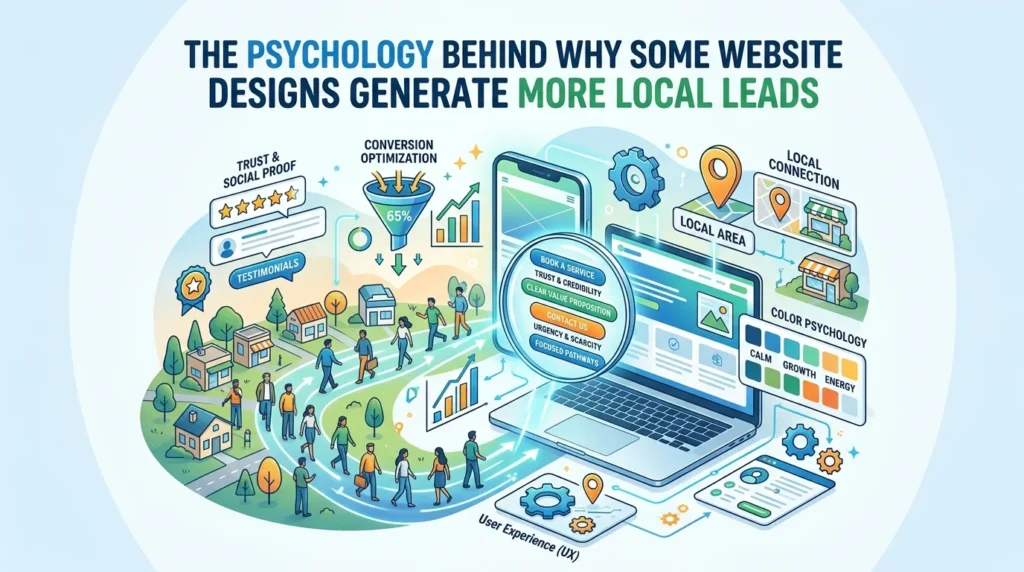
Why do two local businesses offering similar services often generate completely different numbers of leads online?
In many cases, the answer has less to do with pricing or service quality and far more to do with psychology-driven website design.
When someone lands on your website, they begin making judgments almost instantly. Within seconds, visitors decide whether your business feels trustworthy, professional, and worth contacting. These decisions happen subconsciously, long before someone reads your service details or compares prices.
For local businesses, this matters even more.
Whether someone needs a roofer, dentist, attorney, plumber, HVAC company, or local retail store, they usually want reassurance before taking action. They want to feel confident that they are choosing the right business. Your website either strengthens that confidence or quietly destroys it.
A cluttered layout, outdated visuals, confusing navigation, slow loading speed, or weak messaging can push visitors away even if your services are excellent. Meanwhile, a clean, strategically designed website can increase trust, reduce hesitation, and dramatically improve lead generation.
Modern web design is no longer just about aesthetics.
Your website functions as a digital salesperson. Every design choice influences how visitors think, feel, and behave.
In this guide, you’ll learn:
- Why website psychology directly impacts local lead generation
- The hidden psychological triggers behind high-converting websites
- How trust, simplicity, color, layout, and mobile UX affect conversions
- The most common website mistakes that reduce leads
- Practical strategies you can apply immediately to improve conversions
If you want more local leads without constantly increasing your advertising budget, understanding website conversion psychology is one of the smartest investments you can make.
Why Website Psychology Matters for Local Businesses
Most Visitors Decide Within Seconds
Research consistently shows that users form opinions about a website within seconds. Before they read your content, they evaluate:
- Visual quality
- Organization
- Professionalism
- Ease of use
- Mobile responsiveness
This creates what psychologists call a “snap judgment.”
If your website looks outdated, cluttered, or confusing, visitors often assume your business operates the same way. Even if your service is exceptional, a poor presentation immediately lowers confidence.
This is especially important for local businesses because users are often comparing several competitors at the same time.
If another website feels easier to trust, visitors leave quickly.
Common First-Impression Trust Signals
- Clean layouts
- Professional typography
- Fast loading speed
- High-quality images
- Clear contact information
- Mobile-friendly design
- Organized navigation
When these elements are missing, bounce rates rise dramatically.
Trust Is the Core Driver of Local Conversions
Local customers are not simply buying a service.
They are buying reassurance.
When someone hires a contractor, dentist, lawyer, or cleaning company, they are trying to reduce uncertainty. They want confidence that they are making the right decision.
This is why trust plays such a major role in local conversion optimization.
A trustworthy website lowers psychological resistance by making visitors feel safe, informed, and comfortable.
The more confident visitors feel, the more likely they are to:
- Call your business
- Request a quote
- Book an appointment
- Submit a contact form
- Visit your location
For many service businesses, trust matters more than price.
Design Impacts Perceived Credibility
People naturally associate visual quality with competence.
This psychological principle affects almost every industry.
A professionally designed website signals:
- Stability
- Expertise
- Attention to detail
- Reliability
- Authority
An outdated website signals the opposite.
Poor spacing, inconsistent branding, blurry images, difficult navigation, and broken layouts immediately reduce perceived credibility.
This is known as the aesthetic-usability effect. Users tend to believe visually appealing websites are easier to use and more trustworthy, even before interacting deeply with them.
Good design is not decoration.
It is credibility engineering.
The First Impression Effect in Web Design
Visual Appeal and Instant Trust
People process visuals far faster than text.
That means your website’s appearance creates emotional reactions before visitors consciously evaluate your services.
High-converting local business websites typically focus on:
- Clean spacing
- Readable typography
- Consistent branding
- Professional imagery
- Strong visual hierarchy
These elements create cognitive fluency, meaning visitors can process information easily without mental strain.
When information feels easy to understand, people naturally trust it more.
How Layout Influences User Confidence
Layout design directly affects how users interact with your website.
A strong layout guides visitors naturally toward important information and conversion actions.
Good layouts help users quickly identify:
- What your business does
- Who you serve
- Why they should trust you
- What action to take next
This is accomplished through visual hierarchy using:
- Font sizes
- Spacing
- Contrast
- Positioning
- Color emphasis
Users scan websites in predictable patterns.
When information appears in logical places, confidence increases.
Why Cluttered Websites Lose Local Leads
Clutter creates psychological overload.
Too many buttons, pop-ups, animations, colors, menus, or competing messages force users to process excessive information at once.
This increases cognitive load.
When cognitive load rises, users become mentally fatigued and more likely to leave.
Common Clutter Problems
- Overcrowded homepages
- Too many CTA buttons
- Large text blocks
- Excessive menu options
- Distracting sliders
- Auto-playing videos
- Poor spacing
Simple websites reduce friction and help users move smoothly toward conversion actions.
Color Psychology and Local Lead Generation
Colors That Increase Trust
Colors influence emotions and perception.
Different industries often rely on specific colors because they trigger predictable psychological associations.
Examples
- Blue communicates trust, professionalism, and security
- Green suggests growth, health, and stability
- Black communicates luxury and authority
- Red creates urgency and attention
- Orange encourages action and energy
This is why healthcare websites often use blue and green, while luxury brands rely on black and dark neutrals.
The right colors strengthen emotional alignment between your business and your audience.
How CTA Colors Influence Clicks
CTA buttons need visual contrast.
If your “Call Now” or “Request a Quote” button blends into the background, users may overlook it entirely.
High-converting websites use contrast psychology strategically.
Effective CTA Buttons Usually:
- Stand out visually
- Use contrasting colors
- Include whitespace around them
- Appear consistently throughout the website
The goal is not finding a “magic color.”
The goal is visibility.
Matching Colors to Industry Expectations
Different industries benefit from different emotional tones.
Healthcare Websites
Healthcare providers often use calming colors like blue, white, and green because patients seek reassurance and safety.
Law Firms
Legal websites commonly use navy, black, gray, and gold to communicate professionalism and authority.
Home Service Businesses
Roofers, plumbers, electricians, and HVAC companies often benefit from bold, trustworthy color combinations with strong CTA contrast.
Restaurants
Restaurants frequently use warmer colors that stimulate appetite and energy.
Color psychology works best when it aligns with customer expectations.
Social Proof Psychology That Converts Visitors
Why Reviews Influence Buyer Decisions
Humans naturally look to others when making decisions.
This psychological behavior is known as social proof.
When potential customers see positive reviews, they feel reassured that others already trust your business.
This lowers perceived risk.
For local businesses, reviews are especially influential because customers fear making the wrong choice.
Strong Review Signals Include:
- High Google ratings
- Detailed customer feedback
- Recent reviews
- Consistent positive experiences
- Responses from business owners
The more authentic your reviews appear, the stronger the trust transfer becomes.
The Psychology Behind Testimonials
Testimonials work because they create emotional relatability.
Visitors see themselves in the experiences of previous customers.
Story-driven testimonials are especially persuasive because they communicate:
- Problems
- Frustrations
- Solutions
- Positive outcomes
Generic testimonials like “Great service!” are far less effective than detailed customer experiences.
Using Local Proof to Increase Trust
Local relevance strengthens social proof dramatically.
Examples of Local Trust Signals
- Google Reviews from nearby customers
- Local project galleries
- Before-and-after transformations
- Case studies
- Community involvement
- Neighborhood references
When visitors recognize familiar locations or communities, trust increases because the business feels more established and real.
The Role of Simplicity in Conversion Optimization
Reducing Cognitive Load
Simple websites often convert better because they reduce mental effort.
When visitors can quickly understand:
- What you offer
- Why they should trust you
- What to do next
They are more likely to take action.
Every unnecessary element adds friction.
Why Simple Navigation Works Better
Navigation should feel effortless.
Users should never struggle to find:
- Services
- Pricing
- Reviews
- Service areas
- Contact information
Confusing navigation increases frustration and abandonment.
Simple navigation structures improve user confidence and speed up decision-making.
Fewer Choices Often Create More Leads
More options do not always improve conversions.
This principle is explained by Hick’s Law:
The more choices people have, the longer decision-making takes.
Too many offers, buttons, menus, or pathways can create decision paralysis.
Strong lead-generation websites streamline the user journey toward one primary action:
- Call now
- Book appointment
- Request estimate
- Schedule consultation
Focused user journeys consistently outperform cluttered ones.
Mobile Design Psychology and User Behavior
Why Mobile Visitors Behave Differently
Most local searches now happen on mobile devices.
Mobile users are often:
- Distracted
- Comparing businesses quickly
- Searching with immediate intent
- Looking for fast answers
This creates shorter attention spans and faster scanning behavior.
If mobile users cannot find what they need quickly, they leave.
Thumb-Friendly Design Principles
Mobile usability strongly affects conversion rates.
Important Mobile UX Principles
- Large tap targets
- Easy-to-click buttons
- Readable font sizes
- Adequate spacing
- Sticky CTA buttons
- Simplified layouts
Designing for thumbs matters because most users browse with one hand.
Speed and Attention Span Psychology
Page speed directly impacts user psychology.
Slow websites create frustration, impatience, and distrust.
Even small delays can reduce conversions significantly.
A local service business with a 7-second load time may lose customers before users even view the services page.
Fast-loading websites improve:
- User satisfaction
- Trust perception
- Engagement
- Conversion rates
Speed optimization is both a technical and psychological advantage.
Trust Signals That Increase Local Leads
Contact Information Visibility
Visitors want reassurance that your business is legitimate and accessible.
Strong local business websites make contact information highly visible.
Include:
- Phone numbers
- Addresses
- Business hours
- Email addresses
- Contact forms
- Click-to-call functionality
Hidden contact details create uncertainty.
Local Awards, Certifications, and Associations
Authority signals strengthen credibility.
Examples include:
- Industry certifications
- Professional memberships
- Local awards
- Licensing information
- Manufacturer partnerships
People trust businesses that appear established and recognized.
Security Signals and Professional Branding
Security affects conversion psychology more than many businesses realize.
Visitors look for signals such as:
- HTTPS security
- SSL certificates
- Trust badges
- Privacy assurances
- Real team photos
- Satisfaction guarantees
Professional branding matters too.
Authentic photography usually performs better than generic stock images because it feels more trustworthy.
CTA Psychology Why Some Buttons Convert Better
The Power of Action-Oriented Language
Weak CTAs reduce conversions.
Generic buttons like “Submit” lack emotional motivation.
High-converting CTAs use action-oriented language such as:
- Get My Free Estimate
- Book Your Consultation
- Talk to a Local Expert
- Schedule Service Today
These phrases reduce uncertainty and clarify value.
Placement and Visibility of CTAs
CTAs should appear strategically throughout the website.
Important CTA Placements
- Above the fold
- After service explanations
- Near testimonials
- At the end of pages
- In sticky mobile headers
Repetition improves visibility without overwhelming users.
Reducing Anxiety Before Conversion
Many visitors hesitate before contacting a business.
Effective CTAs reduce psychological risk using reassuring phrases like:
- Free consultation
- No obligation
- Fast response
- Transparent pricing
- Speak directly with a local expert
Reducing perceived commitment often increases conversion rates dramatically.
Emotional Triggers That Influence Local Customers
Fear of Making the Wrong Choice
Many buying decisions are driven by fear avoidance.
Local customers worry about:
- Wasting money
- Hiring the wrong company
- Poor workmanship
- Hidden fees
- Unreliable service
Trust-building design reduces these fears through transparency, reviews, guarantees, and credibility signals.
Urgency and Scarcity
Urgency motivates action.
Examples include:
- Same-day appointments
- Limited availability
- Seasonal offers
- Fast response times
Urgency works because people fear missing opportunities.
However, fake urgency damages credibility.
Authenticity matters.
Familiarity and Community Connection
People trust businesses that feel local and familiar.
Community-focused messaging strengthens emotional connection through:
- Local references
- Neighborhood imagery
- Community involvement
- Personalized messaging
- Local team photos
Local identity increases relatability and trust.
Common Website Design Mistakes That Hurt Local Leads
Slow Load Times
Slow websites frustrate visitors quickly.
Many users abandon websites before pages fully load.
Generic Stock Photography
Generic stock photos reduce authenticity.
Visitors want to see:
- Real team members
- Actual projects
- Local work
- Genuine customer experiences
Authentic visuals improve trust dramatically.
Weak Messaging
Visitors should immediately understand:
- What you do
- Who you help
- Why you are different
Weak messaging creates confusion and lowers conversions.
Too Many CTAs
Too many competing actions overwhelm visitors.
A focused conversion path consistently performs better than multiple conflicting options.
Outdated Design
Outdated websites often appear neglected and untrustworthy.
Users may assume the business itself is outdated as well.
Modern, responsive website design improves perceived professionalism immediately.
How to Design a Website That Converts More Local Visitors
Prioritize Clarity Over Complexity
The highest-performing websites are usually the clearest.
Focus on:
- Simple navigation
- Clean layouts
- Clear messaging
- Readable content
- Strong CTAs
Clarity improves user confidence.
Build Around User Intent
Your website should answer the visitor’s most important questions quickly.
Ask yourself:
- What does this visitor need immediately?
- What concerns do they have?
- What information helps them trust us?
Design around customer psychology rather than internal business preferences.
Optimize for Trust and Speed
Trust and usability should guide every design decision.
Prioritize:
- Mobile responsiveness
- Fast loading times
- Professional branding
- Real reviews
- Clear contact details
- Strong social proof
Small trust improvements often create large increases in leads.
Test and Improve Continuously
High-converting websites evolve continuously.
Track user behavior using:
- Heatmaps
- Analytics
- Conversion tracking
- Scroll-depth analysis
- A/B testing
Even small UX improvements can dramatically increase lead generation over time.
Conversion optimization is an ongoing process not a one-time redesign.
Frequently Asked Questions
Why do some website designs generate more local leads than others?
Websites that generate more local leads are usually designed around user psychology. They build trust quickly, reduce confusion, and guide visitors toward taking action. Clear messaging, social proof, fast loading speeds, and visible calls-to-action help local customers feel confident enough to contact the business.
How does website design influence customer trust?
People judge a website within seconds of landing on it. Clean layouts, professional branding, customer reviews, secure browsing, and consistent design signals make a business appear more trustworthy. Poor design, clutter, or outdated visuals can create doubt and increase bounce rates.
What design elements improve local lead generation?
The most effective elements include strong headlines, local testimonials, easy navigation, click-to-call buttons, fast-loading pages, and clear service information. Adding location-specific content and trust badges also helps local visitors feel more comfortable reaching out.
Why is mobile-friendly design important for local businesses?
Most local searches now happen on mobile devices. If a website is hard to use on a phone, visitors often leave immediately. A responsive mobile design improves usability, keeps visitors engaged longer, and increases the chances of calls, form submissions, and bookings.
How do colors affect website conversions?
Colors influence emotions and decision-making. Blue often creates trust, green suggests safety or growth, and red can encourage urgency. The right color combinations help guide attention toward important actions like contacting the business or requesting a quote.
What role does page speed play in lead generation?
Slow websites frustrate users and reduce trust. Even a delay of a few seconds can increase bounce rates significantly. Fast-loading websites create a smoother experience, improve search rankings, and help keep potential local customers engaged long enough to convert.
Why are customer reviews important on a local business website?
Reviews act as social proof. They reassure visitors that real people have had positive experiences with the business. Displaying testimonials, ratings, and case studies can reduce hesitation and make potential customers more likely to contact the company.
How does website navigation affect conversions?
Simple navigation reduces mental effort for visitors. When users can quickly find services, pricing, contact information, and locations, they are more likely to stay on the site and take action. Confusing menus often lead to frustration and lost leads.
What psychological triggers increase website conversions?
Common conversion triggers include trust signals, scarcity, authority, social proof, and clarity. For example, showing certifications, limited-time offers, or customer success stories can encourage visitors to act faster and feel more confident in their decision.
Can improving website design help SEO and local rankings?
Yes. Google favors websites that provide a positive user experience. Fast loading times, mobile responsiveness, easy navigation, and engaging content all contribute to better SEO performance, which can improve visibility in local search results and generate more leads.
Final Thoughts
The highest-performing local business websites are not simply attractive.
They are psychologically optimized.
Every design element influences how visitors think, feel, and behave. Trust, simplicity, speed, clarity, emotional reassurance, and usability all shape conversion decisions.
Businesses that understand this consistently generate more leads without necessarily increasing traffic.
Small improvements in trust signals, mobile usability, CTA clarity, page speed, and visual presentation can create major increases in phone calls, form submissions, and booked appointments.
Your website should not function like an online brochure.
It should function like a lead-generation system.
If your current website is generating traffic but not leads, the problem may not be your marketing; it may be your user experience.
A psychologically optimized website can dramatically increase conversions without increasing ad spend.
Start by improving trust, clarity, and user experience before investing more into traffic generation.