1. Why This Comparison Is No Longer About Features
For over a decade, e-commerce platform evaluations have relied on static feature checklists. Decision-makers compared native inventory fields, basic coupon layouts, and theme libraries.
In 2027, this checklist-driven methodology is obsolete . Both Shopify and WooCommerce can process a credit card, manage a product listing, and send an automated order confirmation email.
The evaluation framework has fundamentally shifted from a surface-level feature race to a deep examination of revenue system efficiency and architectural elasticity.
[Legacy Paradigm: 2015-2024]
Feature Checklists ➔ Cost-Per-Month ➔ Template Choices
[Modern Paradigm: 2027+]
Infrastructure Elasticity ➔ AI Stack Adaptation ➔ Conversion Friction Reduction ➔ Lifetime Value Moats
The Checklist Fallacy and Cognitive Biases
When executing platform selections, growth-stage leadership teams often fall victim to the Feature Completeness Fallacy. This cognitive bias creates the illusion that a system with more configuration checkmarks inherently minimizes business risk.
In reality, unchecked configuration depth introduces significant cognitive overhead, system fragility, and operational debt.
When your brand scales from $1M to $10M and eventually past $50M in annual revenue, your primary operational bottleneck is no longer “Does the platform have a loyalty app?” Instead, the bottlenecks become:
- Systemic Friction: Milliseconds of checkout latency that cause cart abandonment.
- Data Silos: The inability to pipeline first-party data directly into programmatic marketing setups without breaking API boundaries.
- Infrastructure Fragility: Core system failures that occur during high-velocity traffic surges.
What Scaling Natively Demands in 2027
True scale is defined across four interconnected vectors:
- Traffic Surge Elasticity: The platform’s automated capacity to handle sudden concurrent visitor spikes without server degradation.
- Conversion Engine Resilience: Protecting the transaction pipeline from layout shifts, API call delays, and multi-step cart drop-offs.
- Data Moats for AI Stacks: Feeding behavioral algorithms and predictive LTV modules with zero-latency relational data.
- Global Boundary Elimination: Running international localized checkouts, compliance routing, and cross-border currency calculations seamlessly.
This comparative analysis is designed to move past surface-level marketing materials to evaluate how Shopify and WooCommerce function as enterprise revenue engines. You will discover which platform mitigates operational friction, protects your margins under heavy transaction load, and maximizes long-term enterprise valuation.
2. Shopify vs WooCommerce Overview (Modern Context)
2.1 What Shopify Actually Is Today
Shopify has evolved from a simple hosted shopping cart solution into a highly integrated, multi-tenant cloud SaaS commerce operating system. It acts as a managed abstract layer over complex infrastructure.
When you build on Shopify, you enter a structured environment where server clustering, global content delivery network (CDN) edge routing, PCI-DSS Level 1 compliance, and core database tuning are entirely handled by the platform.
The platform sacrifices database-level write permissions to guarantee absolute uptime, lightning-fast transaction pipelines, and predictable scalability.
2.2 What WooCommerce Actually Is Today
WooCommerce is an open-source, highly modular database schema built on top of the WordPress core content management system. It is not an autonomous platform; it is an open framework.
In 2027, enterprise WooCommerce deployments reject standard share-hosting setups in favor of decoupled, object-cached, highly specialized custom application stacks.
WooCommerce offers complete structural sovereignty. You possess absolute ownership over the relational database, every line of server-side PHP, and the underlying server environment. However, this means you are solely responsible for engineering performance, managing security mitigation, and avoiding database fragmentation.
2.3 The Philosophical Ecosystem Split
+————————————————————+
| THE E-COMMERCE PARADIGM SPLIT |
+————————————————————+
| SHOPIFY ECOSYSTEM | WOOCOMMERCE ECOSYSTEM |
| (Hosted Managed Elasticity) | (Open Database Sovereignty) |
+————————————————————+
| * Multi-tenant global cloud | * Decoupled, custom hosting |
| * Immutable core database API | * Direct SQL command execution |
| * Standardized application layer | * Infinite code modification |
| * Frictionless infrastructure shift| * High engineering requirement |
+————————————————————+
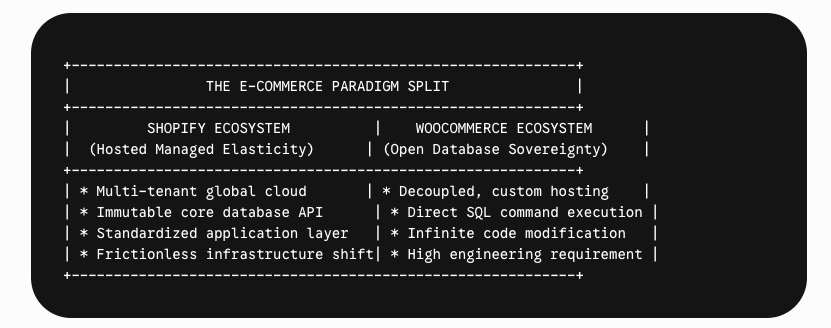
This split introduces the classic Control vs. Convenience Tradeoff.
Psychologically, founders often seek control because they believe it protects their unique product positioning. However, from a conversion design standpoint, excessive control over standard web elements often results in unintentional friction.
Shopify operates on the principle of standardized execution optimizing everything from the cart architecture to payment fields to minimize cognitive friction for the end user.
WooCommerce assumes that the merchant requires absolute flexibility to modify core commerce rules, offering unlimited modification potential alongside an equal amount of engineering risk.
2.4 Real-World Structural Positioning
- Shopify is engineered for: High-velocity direct-to-consumer (D2C) retail brands, multi-channel commerce setups, and rapid-growth companies prioritizing market speed and conversion optimization over technical infrastructure control.
- WooCommerce is engineered for: Complex, developer-led enterprises requiring deep integrations with legacy enterprise resource planning (ERP) systems, non-standard product structures, or hyper-specific data governance models that require local database hosting.
3. The Real Differentiator Scale Ceiling Framework
The Scale Ceiling is the precise point where an e-commerce platform encounters structural bottlenecks under extreme operational stress, resulting in severe performance degradation or total system failure . Platforms do not degrade gracefully; they break at specific structural thresholds when data volume or concurrency limits are exceeded.
TRAFFIC CONCURRENCY SURGE IMPACT:
Shopify:
[Massive Front-End Surge] ➔ [Automated Edge Scale Response] ➔ [Regulated API “Leaky Bucket” Gates for ERP Syncs]
WooCommerce:
[Massive Front-End Surge] ➔ [High Server CPU/RAM Load] ➔ [wp_postmeta Table Lookups Lock] ➔ [Database Deadlock]
3.1 Traffic Scaling Limits (10K → 1M+ Monthly Visits)
As traffic scales from a baseline of 10,000 monthly visits to a multi-channel volume of over 1,000,000 visits, the infrastructure load shifts from simple page delivery to intensive, real-time transactional read/write queries.
- The Shopify Execution Model: Shopify utilizes a highly scalable, multi-tenant global cloud infrastructure backed by automated load balancing and edge server distribution. When traffic spikes from 100 concurrent users to 100,000 during a flash sale or marketing campaign, Shopify absorbs the surge across its entire server ecosystem. The merchant’s site layout requires no adjustments; performance remains stable.
- The WooCommerce Execution Model: WooCommerce relies entirely on the architecture of your specific hosting infrastructure. At 1,000,000 monthly visits, standard database configurations fail. Without advanced Redis object caching, distributed database read replicas, and dedicated server arrays, concurrent traffic surges will cause high CPU and RAM usage, leading to slow page loads or total site drops.
3.2 Checkout Performance Under Stress
The transactional peak of an e-commerce platform is the checkout phase. This is where multiple write queries hit the core database simultaneously to secure inventory, verify payments, and generate order IDs.
- Shopify Checkout Resilience: Shopify separates checkout processing from standard catalog browsing. The checkout platform is isolated and built to handle tens of thousands of processed checkouts per minute without impacting front-end browsing speed.
- WooCommerce Database Bottlenecks (wp_postmeta Table Bloat): By default, WordPress structures data using an Entity-Attribute-Value (EAV) model within the wp_postmeta table. Every single order detail (shipping country, tracking number, tax tiers, item variants) creates a new row in this single table. For a scaling brand with thousands of products and high transactional history, this table frequently scales into millions of rows. When a major traffic wave hits the site, concurrent database reads and writes trigger table locks or database deadlocks during complex SQL execution. This causes the checkout pipeline to hang, resulting in cart abandonment and direct loss of revenue.
3.3 The API Throttling Balance: The Leaky Bucket Constraint
While Shopify excels at handling public front-end traffic, its primary scale ceiling limitation appears on the backend via its strict “leaky bucket” API rate limits.
Shopify allocates a specific request-per-second capacity to every shop instance. If your business infrastructure requires constant real-time communication between an on-premise ERP (like SAP or NetSuite) to sync massive inventories across multiple channels, Shopify will throttle those incoming requests once the bucket overflows.
This can lead to synchronization delays where inventory updates back up during high-volume sales periods.
Conversely, WooCommerce allows you to adjust or eliminate internal API rate boundaries entirely because you control the server architecture. You can optimize your server resources to prioritize internal ERP ingestion requests over any other process.
3.4 Platform Elasticity and Infrastructure Overhead
Shopify offers an out-of-the-box infrastructure SLA that shifts all DevOps liabilities to the SaaS provider.
WooCommerce demands ongoing, highly technical architectural management. To achieve parity with Shopify’s native elasticity, a growing WooCommerce enterprise must implement custom database tables (Custom Product Tables), decouple WordPress using a headless API layout, and run a continuous monitoring array to ensure core code extensions don’t degrade the overall database stack.
4. Revenue Engine Comparison (Not Feature Lists)
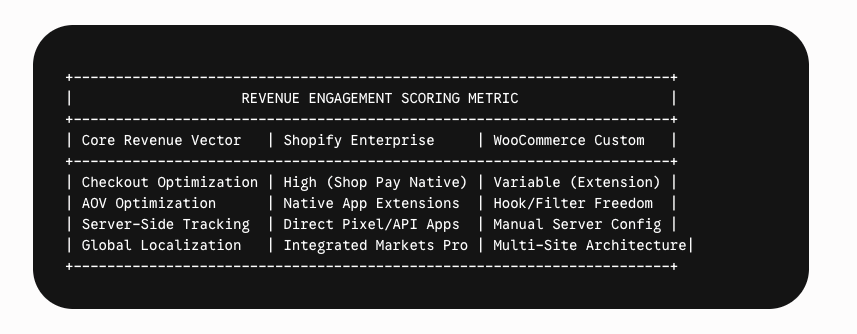
An e-commerce platform shouldn’t be viewed merely as an operational expense; it is the fundamental infrastructure that determines your conversion performance, average order value (AOV), and customer lifetime value (LTV).
+———————————————————————–+
| REVENUE ENGAGEMENT SCORING METRIC |
+———————————————————————–+
| Core Revenue Vector | Shopify Enterprise | WooCommerce Custom |
+———————————————————————–+
| Checkout Optimization | High (Shop Pay Native) | Variable (Extension) |
| AOV Optimization | Native App Extensions | Hook/Filter Freedom |
| Server-Side Tracking | Direct Pixel/API Apps | Manual Server Config |
| Global Localization | Integrated Markets Pro | Multi-Site Architecture|
+———————————————————————–+
4.1 Conversion Rate Impact: The Checkout Friction Paradigm
From a behavioral design perspective, transaction abandonment occurs when the effort required to purchase exceeds the user’s current motivation level.
Shopify addresses this friction point with Shop Pay, its unified, one-click checkout system.
Because millions of global shoppers have their payment credentials, shipping records, and billing data securely stored across the global Shopify SaaS network, a customer can complete an authentication loop and place an order in under six seconds. This frictionless experience can increase checkout conversion rates by up to 10% to 50% compared to standard guest checkouts.
WooCommerce requires the deployment of third-party extensions or extensive custom UI engineering to mimic a streamlined, one-page checkout experience.
Every additional validation plugin, address lookup extension, or payment gateway connector you layer onto WooCommerce introduces new Javascript compilation weight, layout shift risks, and opportunities for code conflicts. This variations in code execution can introduce checkout lag, triggering frustration and cart drops.
4.2 AOV Optimization Capabilities: Upsells, Bundles, and Post-Purchase Flow Mechanics
Maximizing average order value requires the execution of hyper-personalized recommendations at three critical points: pre-checkout cart interactions, checkout page layouts, and post-purchase redirect phases.
- The Shopify Approach: Through its Shopify Functions framework and native checkout app extensions, Shopify allows apps to embed up-sell logic directly within the secure checkout interface without redirecting the user to external verification pages.
- The WooCommerce Approach: WooCommerce utilizes WordPress’s open hook-and-filter system. This allows a developer to inject complex conditional pricing logic directly into the application loop. If your brand requires highly unique, multi-variant pricing matrices (such as B2B trade pricing tiers tied to real-time warehouse availability), WooCommerce provides an open environment to construct that custom business logic.
4.3 LTV Ecosystem Strength: App Stability vs. Plugin Fragmentation
Customer lifetime value relies heavily on retention tools like subscriptions, loyalty networks, and direct customer relationship management (CRM) integrations.
The Shopify App Ecosystem is strictly governed by Shopify’s API guidelines. Apps run externally on separate cloud architectures and pass data through managed endpoints. This prevents a poorly coded third-party subscription app from corrupting your main database structure or crashing your primary storefront front-end.
The WooCommerce Extension Network operates within the same database environment as your core software core. A subscription plugin, a loyalty point tracker, and an automated email marketing module all execute code within the same application loop.
This can lead to software fragmentation, where updating one plugin accidentally disrupts the functionality of another, causing broken checkout paths or missing customer records that impact retention analytics.
4.4 Global Sales Readiness and Localization Execution
Cross-border scaling requires instantaneous adaptation to localized multi-currency checkouts, exact regional tax collection, duties computation, and multi-language variant management.
Shopify provides an out-of-the-box infrastructure called Shopify Markets Pro. It acts as a built-in merchant of record, automatically calculating duties, localized tax risks, and managing international compliance variations immediately at checkout.
To match this capability on WooCommerce, you must manage a complex combination of geo-IP detection plugins, independent tax rate calculation APIs, and multi-currency gateway connectors or route traffic through a complex decentralized WordPress Multisite network tied directly to a middleware routing system.
5. Architecture Breakdown (Headless vs Traditional Commerce)
When a brand scales past $20M in revenue, traditional monolithic architectures can slow down deployment velocities and impact performance flexibility.
This phase typically requires an evaluation of Headless Commerce: separating the front-end display layer from the back-end transaction database.
[Monolithic Architecture]
Front-End (Theme UI) ➔ Bundled Engine ➔ Back-End Database Core
[Headless Architecture]
Front-End UI (Next.js / Hydrogen Edge) ➔ GraphQL API Layer ➔ Decoupled Commerce Engine Core
5.1 Shopify Monolith vs. Headless Hydrogen Flexibility
By default, Shopify functions as a managed monolith using its proprietary Liquid templating language. Liquid is highly secure and fast, but it forces a specific theme framework on development teams.
To allow enterprise brands to go headless, Shopify provides Hydrogen, a developer framework built on React and Remix, hosted directly on Shopify’s global edge rendering platform, Oxygen.
This allows you to create fully custom web interfaces that fetch data from Shopify via the Storefront API. The front-end operates with edge-computed performance speeds, while Shopify continues to securely manage backend checkout processing, security compliance, and order storage.
5.2 WooCommerce Custom Stack Architecture
WooCommerce is naturally unopinionated about its presentation layer. By installing the WPGraphQL plugin, developers can completely decouple WooCommerce, turning the platform into a headless content engine.
The front-end interface can be engineered using framework tools like Next.js or React, hosted on modern edge cloud platforms like Vercel or Netlify.
This layout completely bypasses the standard database-heavy rendering performance limitations of the WordPress template system. It removes front-end catalog lookup execution directly from the main server SQL environment, effectively protecting the database from high traffic volatility.
5.3 Comparative Performance and Maintenance Overhead Benchmarks
- Speed & Core Web Vitals: Headless setups on both systems can achieve near-instantaneous load speeds. However, Shopify Hydrogen benefits from the platform’s optimized cloud network, whereas a headless WooCommerce stack requires your team to manage and coordinate performance optimizations across multiple distinct endpoints (the front-end edge host, the core WordPress API host, and any middleware synchronization scripts).
- Developer Cost Scaling over Time: Building and maintaining a headless stack requires highly specialized engineering resources. While a standard Shopify or WooCommerce monolithic site can be managed by an experienced internal marketing team, headless configurations require ongoing front-end developer retainers to update core components, configure endpoint queries, and ensure API updates don’t break the customer-facing interface.
6. AI-Commerce Readiness (2027–2030 Outlook)
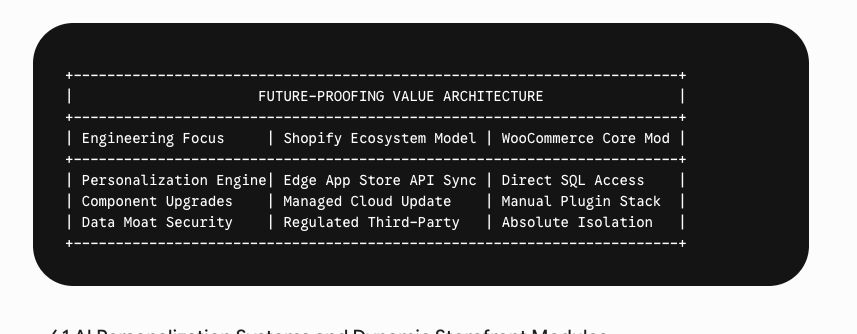
The future of high-volume digital commerce relies heavily on real-time data integration with automated systems: dynamic storefront layouts, behavior-driven recommendation engines, and autonomous data compilation.
+————————————————————————+
| FUTURE-PROOFING VALUE ARCHITECTURE |
+————————————————————————+
| Engineering Focus | Shopify Ecosystem Model | WooCommerce Core Mod |
+————————————————————————+
| Personalization Engine| Edge App Store API Sync | Direct SQL Access |
| Component Upgrades | Managed Cloud Update | Manual Plugin Stack |
| Data Moat Security | Regulated Third-Party | Absolute Isolation |
+————————————————————————+
6.1 AI Personalization Systems and Dynamic Storefront Modules
Modern user experiences have evolved past static, pre-arranged category grids. Advanced storefronts use predictive analysis to dynamically reorganize components based on a user’s intent markers, current traffic source, and historical browsing behaviors.
Shopify utilizes centralized data sets across its entire cloud infrastructure to fuel its native AI engine, Shopify Magic.
Because the platform processes billions of global data points across its ecosystem daily, its machine learning systems can deliver highly accurate predictive suggestions, automated cart bundle optimizations, and natural language search tools directly out of the box.
WooCommerce provides complete access to the underlying raw database schema. This open access allows you to connect specialized on-premise AI models directly to your transaction history without navigating third-party API walls or data ingestion blocks.
However, building and maintaining these integrations requires internal data science engineering resources, whereas Shopify delivers these automation-first features through managed updates.
6.2 Zero-Touch Autonomous Checkout Pipelines
As digital purchasing habits evolve, consumers are moving toward distributed, zero-touch transaction interactions: making purchases through voice interfaces, via predictive automated reorder cycles, or directly inside generative AI interfaces.
Shopify’s unified API architecture ensures that its checkout backend can handle transactional requests from any remote node or generative platform effortlessly.
WooCommerce can replicate these automated workflows via custom API development. However, because its ecosystem is highly fragmented across individual plugin developers, standard configurations face higher security liabilities and connection risks when opening core payment endpoints to autonomous third-party agents.
7. Total Cost of Ownership (TCO) Analysis
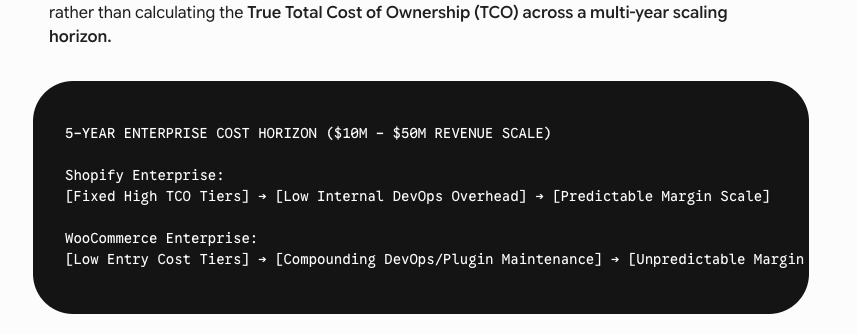
A common mistake made by growth-stage companies is looking only at surface subscription costs rather than calculating the True Total Cost of Ownership (TCO) across a multi-year scaling horizon.
5-YEAR ENTERPRISE COST HORIZON ($10M – $50M REVENUE SCALE)
Shopify Enterprise:
[Fixed High TCO Tiers] ➔ [Low Internal DevOps Overhead] ➔ [Predictable Margin Scale]
WooCommerce Enterprise:
[Low Entry Cost Tiers] ➔ [Compounding DevOps/Plugin Maintenance] ➔ [Unpredictable Margin Cross]
7.1 Setup Costs vs. Long-Term Maintenance Reality
- Shopify: Requires a predictable fee structure. High-volume brands utilize Shopify Plus (starting at a fixed monthly minimum). This is paired with transaction fee components and variable app subscription overhead. However, it eliminates internal costs for server configuration, security patches, and emergency infrastructure resolution.
- WooCommerce: The underlying core software framework is free, but scaling it safely requires significant financial investment. Enterprise-grade WooCommerce hosting environments require dedicated multi-server arrays or elastic cloud infrastructure. This is coupled with premium plugin licenses, custom data monitoring setups, and substantial engineering retainers to ensure system stability.
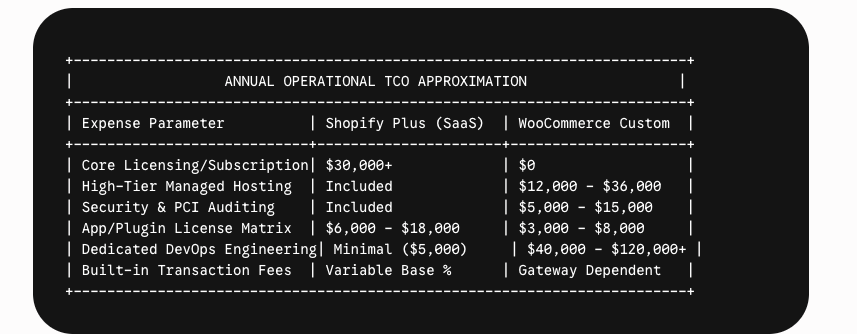
7.2 Five-Year Cost Scaling Projections
Let’s analyze the financial performance curve as an enterprise scales from $10M toward an 8-figure revenue operation:
+————————————————————————-+
| ANNUAL OPERATIONAL TCO APPROXIMATION |
+————————————————————————-+
| Expense Parameter | Shopify Plus (SaaS) | WooCommerce Custom |
+—————————-+———————-+———————+
| Core Licensing/Subscription| $30,000+ | $0 |
| High-Tier Managed Hosting | Included | $12,000 – $36,000 |
| Security & PCI Auditing | Included | $5,000 – $15,000 |
| App/Plugin License Matrix | $6,000 – $18,000 | $3,000 – $8,000 |
| Dedicated DevOps Engineering| Minimal ($5,000) | $40,000 – $120,000+ |
| Built-in Transaction Fees | Variable Base % | Gateway Dependent |
+————————————————————————-+
7.3 Where the Margin Curves Cross
The financial decision framework relies on evaluating Opportunity Cost vs. Engineering Overhead.
WooCommerce minimizes direct platform licensing fees, but its operational cost curve rises steeply due to the specialized developer hours required to maintain, patch, and scale the custom code database.
Shopify carries clear, upfront recurring subscription costs, but its operational curve remains flat because it eliminates infrastructure maintenance liabilities.
An enterprise brand must determine if its internal team’s time is better spent managing database optimization scripts or focusing entirely on conversion optimization, product development, and brand growth.
8. Migration Risk & Switching Costs
Replatforming an active e-commerce brand is a complex operation that carries significant risks to data integrity, search engine visibility, and ongoing transaction velocity.
MIGRATION RISK ASSESSMENT HEATMAP:
WooCommerce ➔ Shopify:
[Data Mapping Complexity: Med] ➔ [SEO URL Structure Risk: High] ➔ [Friction Reduction ROI: Immediate]
Shopify ➔ WooCommerce:
[Infrastructure Overhead: Critical] ➔ [Database Migration: Complex] ➔ [DevOps Cost Scaling: Immediate]
8.1 Replatforming from WooCommerce to Shopify
- The Strategic Value: Migrating to Shopify reduces operational maintenance, stabilizes the checkout pipeline, and lowers internal IT dependencies.
- The Operational Risks: The primary friction point is structural data transformation. Converting historical WordPress relational customer records, order histories, and nested metadata values into Shopify’s structured customer profiles requires precise database mapping. Legacy customer account passwords cannot be directly exported due to security encryption rules, requiring a structured post-migration account activation strategy.
8.2 Replatforming from Shopify to WooCommerce
- The Strategic Value: Migrating to WooCommerce provides complete data ownership, removes ongoing platform transaction fee structures, and allows for unrestricted customization of core system logic.
- The Operational Risks: Your company assumes immediate, full liability for all infrastructure scalability. If the site migration occurs without first stress-testing database clustering configurations, the new system can fail on launch day under standard traffic volumes, directly impacting revenue momentum.
8.3 SEO Equity Preservation and Visibility Safety
The most significant financial risk during platform migration is the loss of organic search visibility and historical indexing value.
Shopify enforces a rigid URL subfolder hierarchy that cannot be bypassed for standard pages:
Legacy WooCommerce Path: site.com/product-name/
Required Shopify Path: site.com/products/product-name/
Because you cannot match these folder pathways exactly, every product, category, and content page must be mapped through a flawless 301 redirect matrix.
Any errors or missed links during this process will generate widespread 404 errors, causing search index drops and impacting keyword rankings.
Furthermore, you must ensure that structured schema markup, image metadata, and site loading speeds are carefully optimized post-migration to prevent visibility declines within modern AI search layouts and search engine overview systems.
9. Founder Decision Matrix (Core Section)
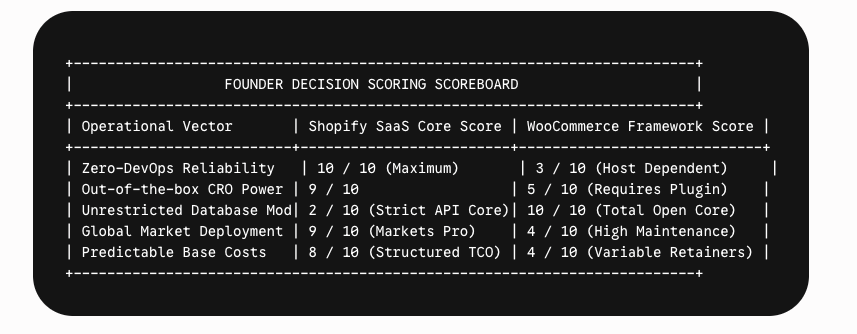
To cut through the theoretical debate, use this objective scoring model to evaluate which e-commerce platform matches your current operational reality, team skill sets, and scaling goals.
9.1 Strategic Operational Parameter Scoring Matrix
Evaluate your organization across these five foundational operational vectors. Assign a weight factor based on your immediate 12-month scaling objectives.
+————————————————————————–+
| FOUNDER DECISION SCORING SCOREBOARD |
+————————————————————————–+
| Operational Vector | Shopify SaaS Core Score | WooCommerce Framework Score |
+————————–+————————-+—————————–+
| Zero-DevOps Reliability | 10 / 10 (Maximum) | 3 / 10 (Host Dependent) |
| Out-of-the-box CRO Power | 9 / 10 | 5 / 10 (Requires Plugin) |
| Unrestricted Database Mod| 2 / 10 (Strict API Core)| 10 / 10 (Total Open Core) |
| Global Market Deployment | 9 / 10 (Markets Pro) | 4 / 10 (High Maintenance) |
| Predictable Base Costs | 8 / 10 (Structured TCO) | 4 / 10 (Variable Retainers) |
+————————————————————————–+
9.2 The Weighted Choice Model
- If your combined organizational requirement score favors Infrastructure Stability, Rapid Market Scaling, and Standardized High-Conversion Checkouts: Shopify is the optimal strategic path.
- If your combined organizational requirement score favors Deep System Customization, Absolute Control Over Relational Data, and Unrestricted Database Modifications: WooCommerce is the optimal strategic path.
10. Use Case Scenarios
10.1 High-Growth Direct-to-Consumer (D2C) Retail Brand
- Operational Profile: Scaling rapidly from $2M toward $15M in annual revenue, running high-impact influencer marketing campaigns, and launching weekly product drops that trigger sudden traffic spikes.
- Platform Selection: Shopify Wins Decisively.
- Strategic Justification: A brand focused on rapid customer acquisition cannot afford to allocate engineering hours to server optimization or database deadlock resolution. Shopify’s native infrastructure absorbs sudden traffic spikes effortlessly, while Shop Pay minimizes checkout friction to capture conversions when consumer motivation is highest.
10.2 Complex Multi-Market Enterprise with Legacy ERP Infrastructure
- Operational Profile: Processing B2B trade configurations alongside D2C sales channels, managing decentralized multi-warehouse fulfillment, and requiring real-time, non-standard field mapping with an on-premise SAP engine.
- Platform Selection: WooCommerce (or Decoupled Headless WooCommerce) Wins.
- Strategic Justification: When business growth requires deep customization of core transaction workflows, Shopify’s standard API rate limitations can become an obstacle. WooCommerce provides the open database access necessary to build complex, bidirectional data pipelines, allowing developers to optimize internal processing systems without platform-enforced constraints.
10.3 Content-Driven Media Ecosystem with Integrated Commerce Channels
- Operational Profile: Managing a high-traffic editorial site or media publication platform with thousands of informational articles, running an active community portal, and selling curated merchandise directly within the content layout.
- Platform Selection: WooCommerce Wins Decisively.
- Strategic Justification: Running a content-heavy digital ecosystem within Shopify requires syncing data across separate blog subdomains or patching software across isolated systems. Because WooCommerce operates directly within the native WordPress core ecosystem, your team can integrate transaction elements directly into high-traffic content assets, maximizing organic user pathways without platform layout restrictions.
11. Final Verdict Which Platform Scales Better?
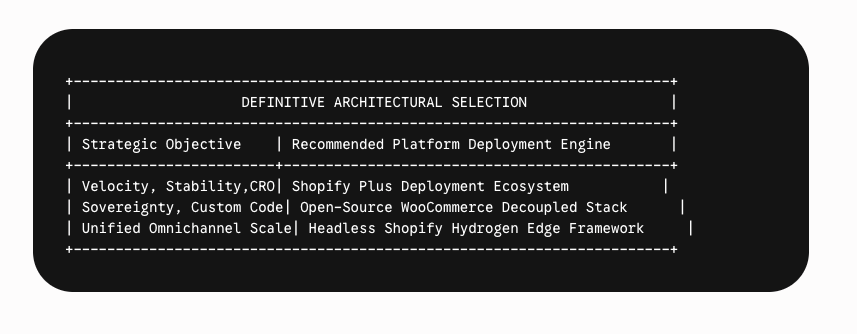
There is no generic winner in the e-commerce landscape; there are only specific solutions tailored to different business environments.
+———————————————————————–+
| DEFINITIVE ARCHITECTURAL SELECTION |
+———————————————————————–+
| Strategic Objective | Recommended Platform Deployment Engine |
+————————+———————————————-+
| Velocity, Stability,CRO| Shopify Plus Deployment Ecosystem |
| Sovereignty, Custom Code| Open-Source WooCommerce Decoupled Stack |
| Unified Omnichannel Scale| Headless Shopify Hydrogen Edge Framework |
+———————————————————————–+
11.1 When Shopify Wins Decisively
Shopify is the superior scaling platform for companies that prioritize operational efficiency, rapid feature deployment, and reliable checkout infrastructure. It removes the maintenance liabilities of server management, allowing growth-stage leadership teams to focus entirely on conversion performance, marketing execution, and revenue velocity.
11.2 When WooCommerce Wins Decisively
WooCommerce is the superior scaling engine for enterprise teams that view absolute software sovereignty as a non-negotiable business requirement. It excels when your business model requires modifying core database rules, managing hyper-specific backend configurations, or integrating deeply with complex legacy enterprise software arrays.
11.3 The Hybrid Path: Headless Commerce Resolution
For enterprise brands that want to bypass this compromise, the optimal choice is a decoupled headless architecture. By combining a custom React or Next.js front-end with Shopify’s Storefront API or a decoupled WooCommerce backend, you can build a hyper-customized user experience while maintaining a secure, scalable transaction processing environment.
12. Final Thoughts
Choosing your e-commerce platform is not merely a technical choice; it establishes the foundational architecture of your entire revenue generation pipeline.
Continuing to evaluate Shopify and WooCommerce through outdated feature checklists ignores the operational realities of modern digital commerce.
Every point of friction in your system directly impacts your conversion performance, increases cart abandonment, and degrades your operational efficiency.
Before migrating your data or restructuring your codebase, analyze your internal organizational strengths:
- If your strategic competitive advantage lies in marketing agility, conversion optimization, and rapid market deployment, choose Shopify to protect your margins from infrastructure risk.
- If your competitive advantage relies on deep technical custom logic, complex legacy system integrations, and absolute data sovereignty, choose WooCommerce and invest in the specialized engineering resources required to maintain it safely.
Align your platform decision with your long-term operational goals to ensure your technology stack acts as a launchpad for your scaling brand rather than a bottleneck to your growth.